

Thomas Edison’s invention of the incandescent light bulb and a complete system for generating and distributing direct current was a scientific breakthrough that changed the world. The electric era officially began on September 4, 1882. On that day, the Pearl Street Station fired up in Manhattan’s financial district, becoming Edison’s first commercial power plant in the United States. It supplied electricity to a large number of New Yorkers until more efficient plants eventually took its place. Read on to learn more at manhattanname.
History
The Pearl Street Station began generating power using coal as fuel, initially serving 82 customers. By 1884, its customer base had grown to 508. The plant was first equipped with high-speed Porter-Allen steam engines, but their sensitive governors led to their replacement. New engines from Armington & Sims proved more suitable for the task. This marked the beginning of electricity’s practical and commercial use. Previously, it was mostly a novelty, seen in items like children’s toys. The light fixtures themselves looked like copper oil lamps that had been retrofitted for electricity.
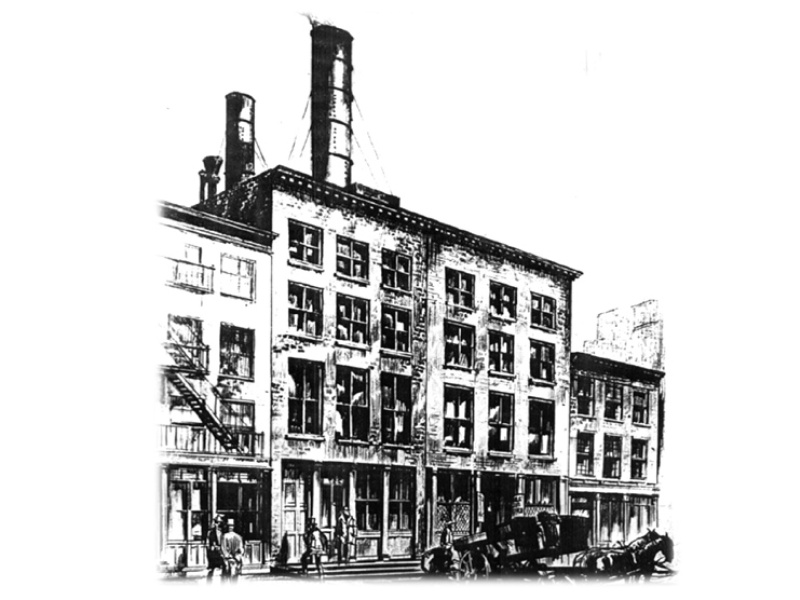
The station served what was known as the “First District,” an area bordered by Spruce Street, Wall Street, Nassau Street, and the East River. This was the world’s first underground urban grid. Thomas Edison used direct current (DC) to power the buildings, though today DC is mostly used for low-voltage appliances.
In 1890, a fire broke out at the Pearl Street Station. It destroyed all but one of the dynamos—the generators that produced direct current. The sole surviving dynamo is now preserved at the Greenfield Village Museum in Michigan. Edison and his team worked around the clock for 11 days to get the station back online. It remained in operation until it was finally decommissioned in 1895.
Scale Models
In 1929, the Edison Company constructed three large-scale working models of the Pearl Street Station. The project was overseen by John W. Lieb, the company’s senior vice president. Lieb had served as Edison’s chief electrician during the station’s construction. He was the man who flipped the main switch on September 4, 1882, initiating the flow of DC power to customers in the First District on Thomas Edison’s command.
Under the direction of Shops Superintendent George C. Jessop, 31 skilled mechanics dedicated about six months to constructing the three models. A small push-button motor animated the models, turning the dynamos, reciprocating engines, forced-draft fans, and other operational machinery. A panel of lights connected to labeled buttons illuminated different sections of the building. Cutaways in the model’s side revealed the equipment on each of its four levels: boilers on the bottom floor, dynamos and engines on the reinforced second floor, and the top two floors dedicated to regulators, test lamp banks, and storage.
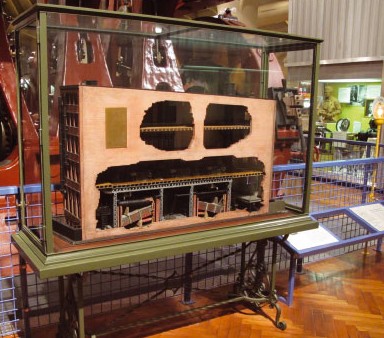
These models survive today and are exhibited at the Smithsonian’s National Museum of American History in Washington, D.C., the Con Edison Learning Center in New York, and The Henry Ford Museum in Dearborn, Michigan.