

The Murray Hill reservoir, also known as the “Fifth Avenue Fortress,” serves as a testament to the fact that despite the progress and achievements of New York, many of our fundamental needs remain unchanged from the time of our ancestors. Manhattan has become adept at disguising the less attractive aspects of its infrastructure. Read more on manhattanname.
Psychiatric hospitals and specialized medical centers still exist, but they no longer occupy eerie Gothic-style buildings. Prisons have been relocated to islands or inconspicuous beige towers with minimal visible security measures, unlike the infamous Tombs prison in Five Points.
Similarly, our trains, electricity, and water supply are mostly underground, out of the attention and thoughts of local residents. Although there are a few exceptions, such as water towers that pierce the skyline and evoke images of a romantic comic book landscape. However, these water treatment structures are mostly located in remote areas and are not intended to be aesthetically pleasing.
The era of reservoirs has already passed
However, some reservoirs, which supply water to the city on a daily basis, are magnificent structures of exceptional beauty, with notable examples being the Murray Hill and Jerome Park reservoirs in Manhattan and the Bronx, respectively. Despite their status as “landmarks,” these objects stand completely empty: they merely serve as reminders of the world’s largest seasonal swimming pools. As New York and its five boroughs grew, so did the water needs of the local residents. Several reservoirs were constructed to meet the demands of the entire city.
The Croton Aqueduct, completed in 1842, brought fresh water from the northern part of the state of New York to the city and the Old Croton reservoir was built to store it. Located at the site of the present-day Bryant Park, the reservoir was a massive open-air basin surrounded by a 50-foot granite wall. Read on to discover the role that Murray Hill specifically played in supplying water to Manhattan.
Source of the photo: https://www.boweryboyshistory.com/
Reservoirs Utilized Daily by the Inhabitants
Several reservoirs were constructed near the terminus of the aqueduct in Manhattan. The York Hill Reservoir (receiving reservoir) covered an area of up to 31 acres (or 13 hectares), had a capacity of up to 150 million gallons (or 568 thousand cubic meters) and was located between Sixth and Seventh Avenue and 79th and 86th Streets (present-day location of the Great Lawn in Central Park). From this location, two pipes with a diameter of three feet (approximately 0.9 meters) conveyed water southward under Fifth Avenue to the Murray Hill Reservoir (which served as a distribution reservoir).
Situated on the western side of Fifth Avenue between 40th and 42nd Streets (current location of the New York Public Library), the Murray Hill Distribution Reservoir covered an area of four acres (or 1.6 hectares) and had a capacity of up to 20 million gallons (or 76 thousand cubic meters). The reservoir’s walls were adorned with an Egyptian cornice and had an average height of 44.5 feet (14 meters) above street level. Water circulated throughout the city from the Murray Hill Reservoir via a network of pipes spanning 170 miles (or 274 kilometers) with diameters ranging from 6 to 36 inches (approximately 15 to 91 centimeters).
Resolving the Issue of Providing Water to Manhattan
According to official historical chronicles, on June 22, 1842, water began to flow through the historic Croton Aqueduct. To commemorate this momentous event, members of the commission and aqueduct engineers embarked on a unique expedition aboard the “Croton Maid” – a vessel specially constructed for this purpose. The boat was modest in size, measuring only sixteen feet long and four feet wide, capable of accommodating only four individuals. The crew took turns boarding the boat, which moved through the aqueduct at a steady speed of approximately 2 miles per hour. After a day of travel, they reached High Bridge in the latter part of the following day. On June 27, the boat was ferried across the Harlem River and carefully placed back into the aqueduct. It resumed its journey and finally arrived at the York Hill reservoir, greeted by a thunderous salute from 38 cannons.
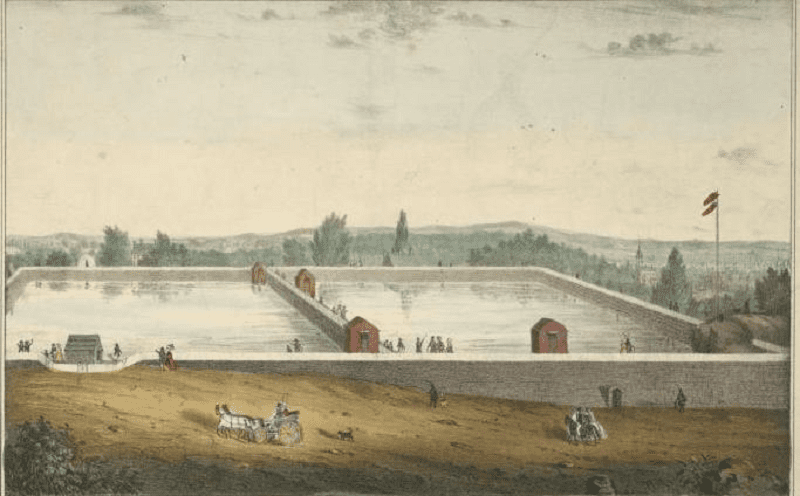
Source of photo: https://www.boweryboyshistory.com/
The Croton Aqueduct Barrier, also known as the Cornell Barrier, is a unique water chute with a curvilinear structure meticulously designed to optimize energy dissipation. On July 4, 1842, water began to flow into the Murray Hill reservoir located on 42nd Street. On October 14, the entire New York City celebrated the completion of the Croton Aqueduct: a grand spectacle was officially arranged. A 50-foot stream of pristine Croton water erupted from the fountain in City Hall Park, sourced from Westchester County.
The event was accompanied by a hundred salutes and pyrotechnic explosions, and the population had the opportunity to take part in the celebration, diverting from their work. The parade procession started near Battery, passed through Union Square and concluded in City Hall Park. The original Croton Fountain once occupied the southern end of City Hall Park until 1870 when it was demolished to make way for the Federal Post Office. Although the fountain no longer exists, the space it once occupied is commemorated by the stone adjacent to Jacob Wray’s fountain.
Water Issues Due to New York City’s Growth
Despite the reliable water supply provided by the Croton Aqueduct, New York City experienced significant population growth, which increased compared to the statistics of the 1840s and 1870s (officially tripled in number). As a result, the city required an expanded aqueduct to meet the growing water demands. In 1885, the construction of a new aqueduct began to satisfy the city’s needs and was officially opened in July 1890.
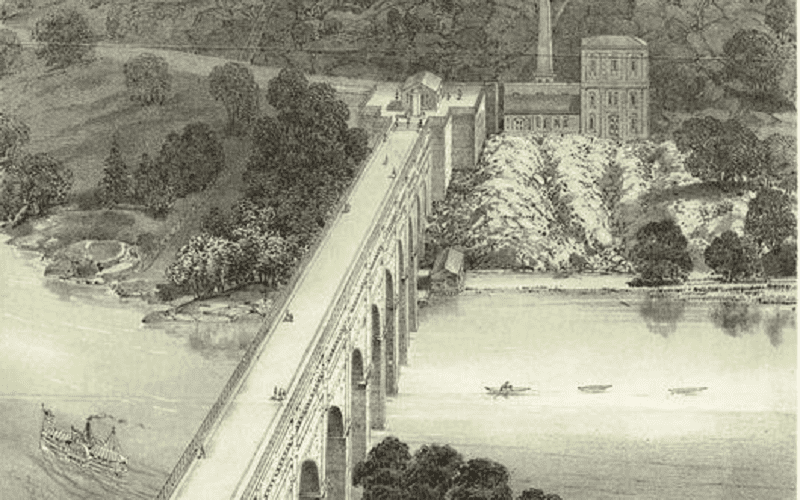
Source of the photo: https://www.boweryboyshistory.com/
The Croton Aqueduct, which was associated with Murray Hill, had an impressive capacity of 340 million gallons (up to 1.2 million cubic meters) per day, three times more powerful than its predecessor. It continues to operate to this day. This massive structure, stretching 31 miles (or 50 kilometers), was carefully designed as an underground passage, including a 7-mile (11 km) inverted siphon under the Harlem River, ingeniously created using diamond drill holes that reached a staggering depth of 300 feet (91 meters) beneath the Earth’s surface.
Connection between the important aqueduct and the distributing reservoir
As mentioned earlier, the significant Croton aqueduct was connected to the Murray Hill distributing reservoir, which served as the second distribution point for the water. In the mid-19th century, the growing population of Manhattan required an expansion of the water supply. In response to this, a freshwater reservoir was constructed, covering the area between Fifth and Seventh Avenues, extending from 86th to 96th Streets. The construction of the reservoir, known as the Manhattan Lake, was completed on August 19, 1862 and its capacity amounted to 1.03 billion gallons, spread across 96 acres of land.
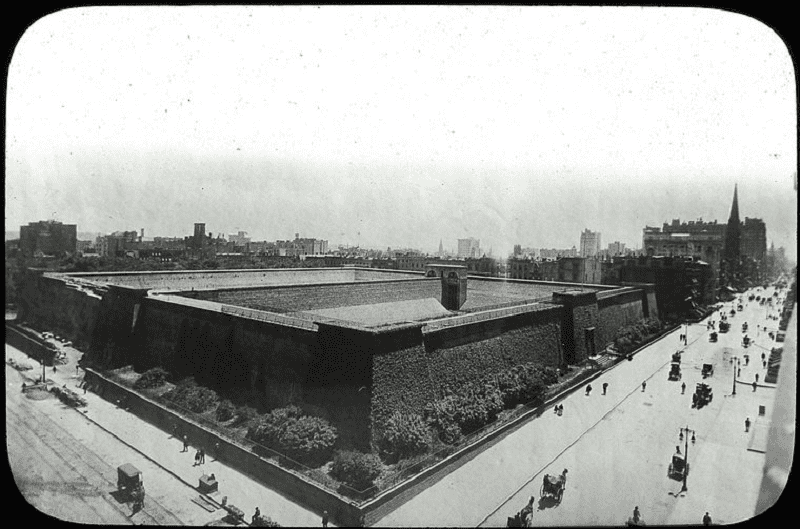
Source of the photo: https://www.boweryboyshistory.com/
Unlike the fate of the York-Hill reservoir, which was drained and transformed into the Great Lawn and Turtle Pond in 1930, Manhattan Lake (or Murray Hill) was ingeniously designed to harmonize with the natural undulating forms of the landscape. The Murray Hill reservoir also ceased to exist in 1899, making way for the New York Public Library, which ceremoniously opened its doors in 1911.
In modern times, many of these historic reservoirs have been repurposed or completely demolished, but their legacy continues to live on. They are a testament to the ingenuity and foresight of those who built them and serve as a reminder of the importance of water in sustaining the growth and prosperity of the city. The Murray Hill Reservoir, located on the site of the Crystal Palace, was a popular tourist attraction in the 19th century but was later demolished to make room for new buildings.