

Central Park is one of the most visited and largest parks in Manhattan. Both locals and tourists are eager to reach it. The park has an enormous area with a large number of plants, animals, ponds and architectural structures. Read more about Central Park on manhattanname.
Establishment of the park
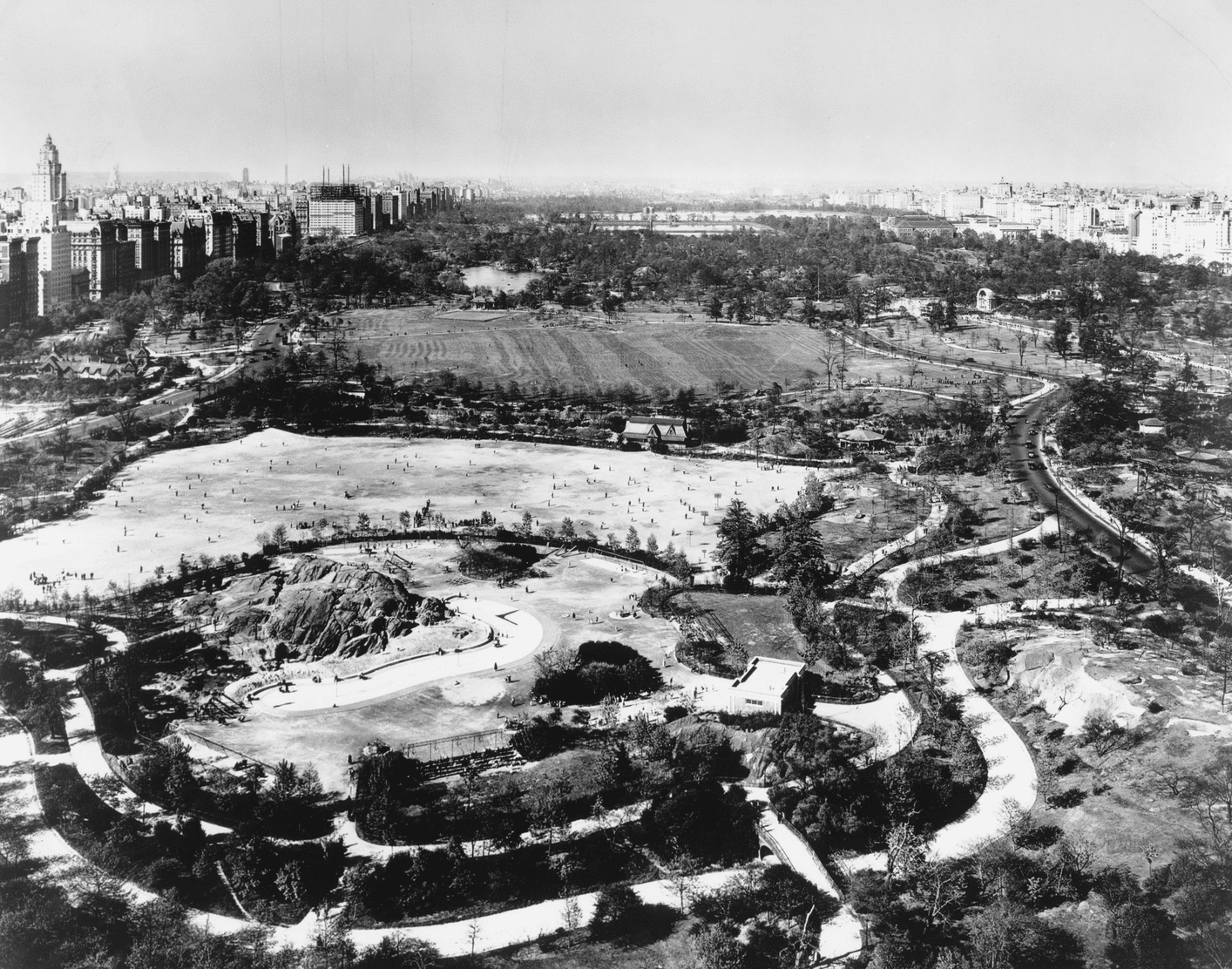
Central Park is the first landscape park in the United States. It is in midtown Manhattan, between the Upper West Side and Upper East Side neighborhoods.
In the nineteenth century, Manhattan was developing steadily. The need for a large public park arose. Therefore, the then Mayor of New York City, Ambrose Kingsland, submitted an application to the Land Committee on the need to build such a site. The Land Committee approved the proposal and began searching for sites. However, for a number of reasons, all of the options he proposed were rejected. Subsequently, the president of the Croton Aqueduct Department, Nicholas Dean, proposed the best option. It was to build a park in the city center, between the Upper West Side and Upper East Side neighborhoods. The proposal was approved.
Before construction, a competition program was held to select the best designs. The competition requirements included a detailed architectural plan that would include playgrounds, intersecting paths, a plaza and an additional reservoir near the existing Yorkville Reservoir. As a result, the project by two American architects, Calvert Vaux and Frederick Law Olmsted, won.
In general, the work on the Central Park was carried out by professionals. In addition to the selected architects, the project was also worked on by Jacob Wrey Mould, Andrew Haswell Green, Ignaz Anton Pilat and George E. Waring Jr.
The park construction was not easy. The swampy and rocky area caused a lot of trouble. A large amount of explosives had to be used to clear the area. At that time, 18,500 cubic yards (14,100 cubic meters) of soil were removed. At the end of August 1857, workers began to build fences, drain the land and level the unevenness. Work on the construction of an additional reservoir began in 1858. In general, the construction was not without problems. For some time, there were significant delays in funding.
The first part of the park was opened to the public in 1858. But the official construction of Central Park was completed in 1876. Since its opening, the park has been very sought after. By 1867, it accommodated almost 3 million pedestrians, 85,000 horses and 1.38 million vehicles annually. It is not surprising, as the park hosted various events for different segments of the population.
As early as 1963, Central Park became a national historic landmark. In 1974, it became a scenic landmark in NYC.
Flora of the park
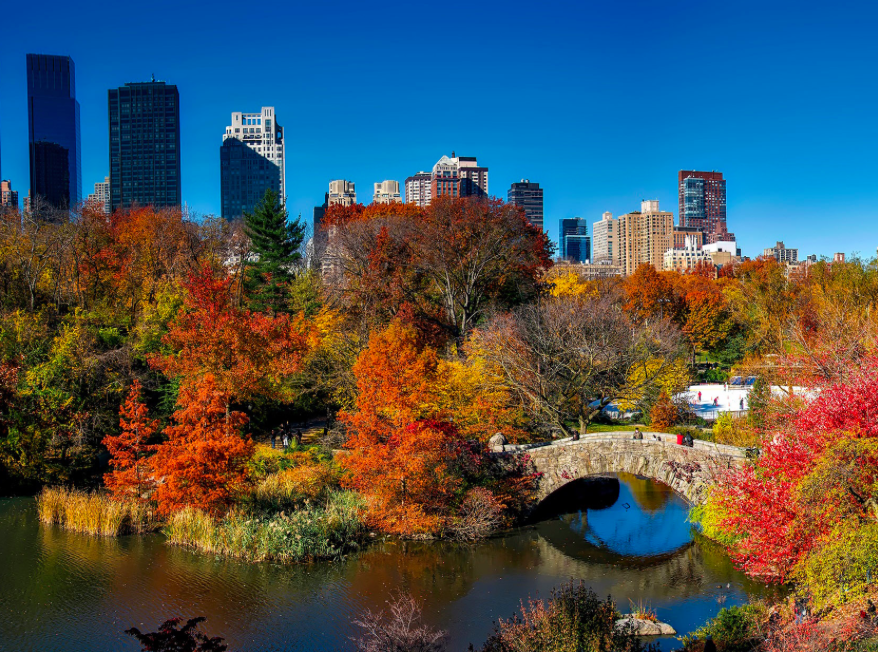
In total, Central Park has three forested areas: North Woods, The Ramble and Hallett Nature Sanctuary. North Woods is the largest forest area. It is in the northwest corner of Central Park and covers about 90 acres (36 hectares). The Ramble is in the southern third of the park near the lake. The area of the territory is from 36 to 38 acres (15-15 hectares). Accordingly, Hallett Nature Sanctuary is in the southeastern corner of Central Park. It is the smallest forested zone of 4 acres (1.6 hectares). The trees in the park include pine trees, tupelo, various types of cherries, evodia, etc.
There are also ponds in the park. In the northeast of the park is a small lake, Harlem Meer. It covers almost 11 acres (4.5 hectares). To the south of Harlem Meer is the Jacqueline Kennedy Onassis Reservoir. It covers 106 acres (43 hectares). A little lower down is the so-called Turtle Pond. Between 66th and 79th Streets is a small 20-acre (8.1 hectare) lake. It was originally intended for boating in the summer and ice skating in the winter.
Fauna of the park
Generally, the park is home to a diversity of birds. The first official list included about 300 species of birds. This list includes such bird species as red-tailed hawk, mandarin duck, owl, wood duck, American black duck, field duck, Canada goose and many others. There are also about ten species of mammals in Central Park, including bats, raccoons, squirrels, chipmunks and opossums. In addition, the park is home to turtles, fish, frogs and more.
The park’s art objects
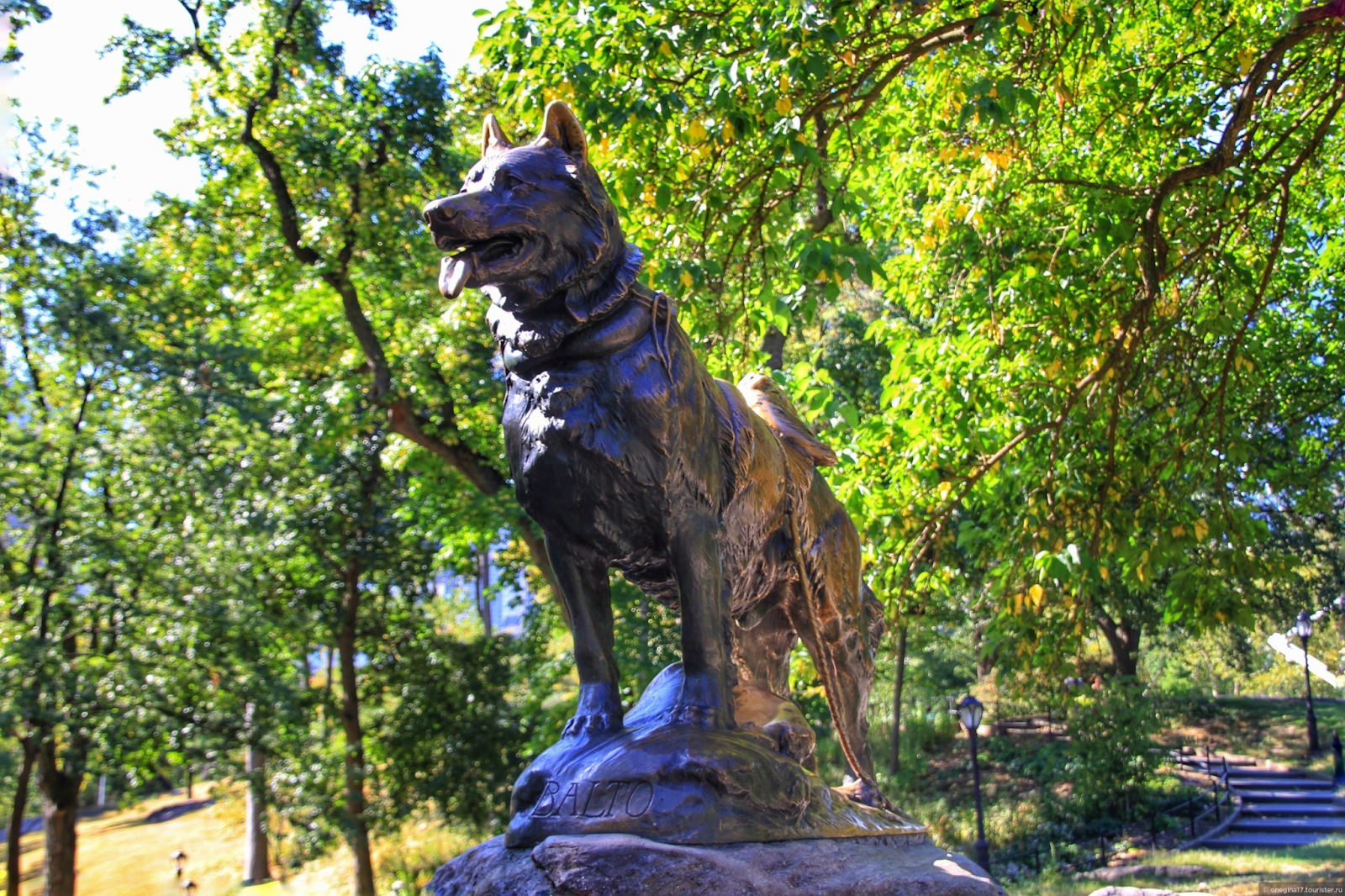
The park also has a large number of different art objects, such as fountains, monuments, sculptures, etc. In general, we can highlight the statues of the Angel of the Waters, Balto, monuments to Sherman, King Jagiello, Sojourner Truth, Susan B. Anthony and Elizabeth Cady Stanton, the Cleopatra’s Needle obelisk, the Strawberry Fields memorial, etc.