

This article explores Morgan Iron Works, once a prominent American manufacturer of marine steam engines. At its peak, the facility was renowned for its sheer scale of production, but it eventually ceased operations around 1907. Discover more about its founding, operations, challenges, and successes below, courtesy of manhattanname.
Founding and Early Development
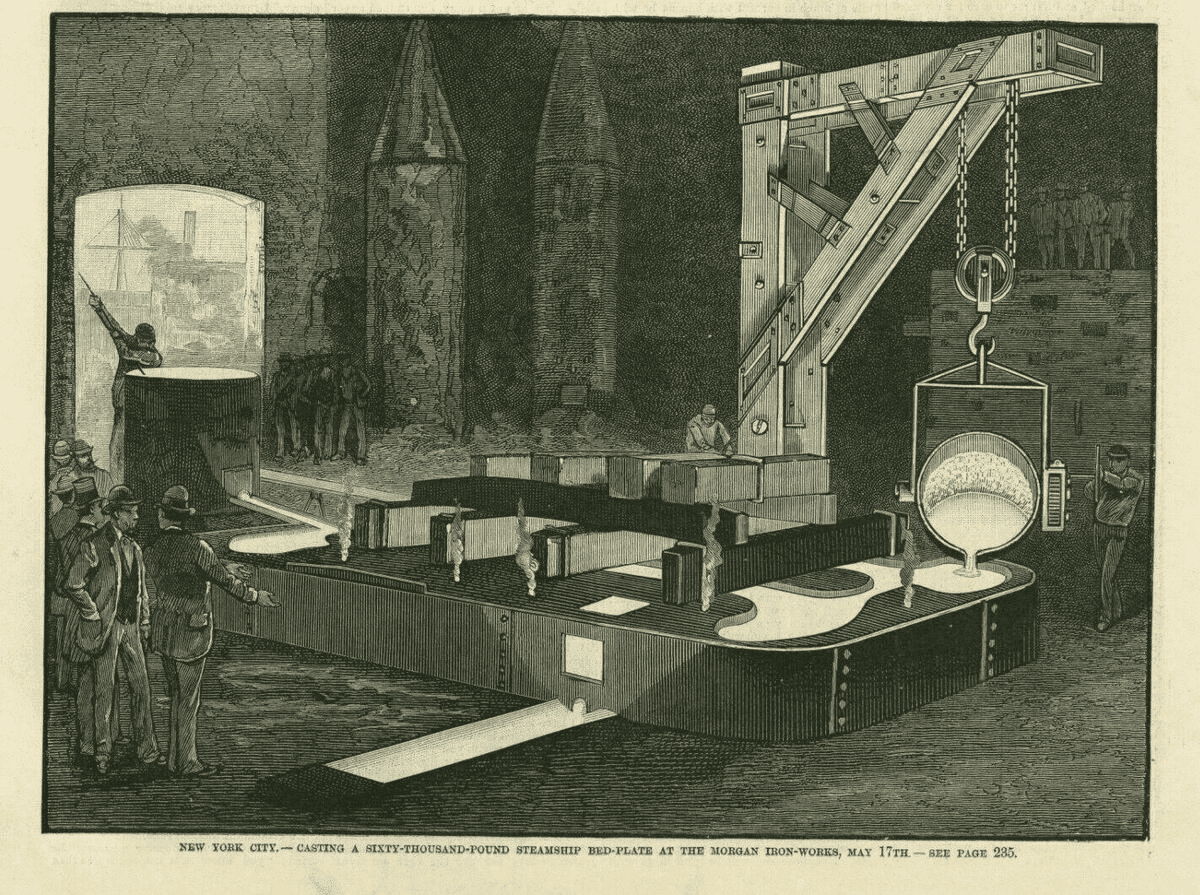
Morgan Iron Works was a leading U.S. manufacturer of marine steam engines. Originally established in 1838 as “TF Secor and Co.” by three partners – Charles Morgan, William K. Collyer (corrected from Kolkin for likely name), and Theodosius Fowler Secor – the plant was located on East 9th Street in Manhattan. Initially, the newly formed works employed about seven hundred workers, building engines for coastal and ocean-going steamships. Soon, due to the high demand for steamships, the plant underwent expansion. In 1850, Charles Morgan bought out his co-owners’ shares and renamed the company Morgan Iron Works.
By the 1860s, ownership stakes in the works had passed to co-owners Whitney and Quintard. Whitney eventually departed the firm. George W. Quintard took the initiative to modernize the plant, installing a floating derrick, steam hammers, and other advanced equipment. He also diversified its output, beginning production of equipment for the Chicago waterworks company and Cuban sugar plantations. Notably, one of the plant’s largest clients was Morgan himself, who operated his own shipping business. By the late 19th century, the works stood as one of the premier engine producers. Within a single decade, Morgan Iron Works had manufactured engines for approximately fifty vessels.
Morgan Iron Works During the Civil War
The U.S. Civil War, which began in 1861 and lasted until 1865, proved to be a period of immense profitability for Morgan Iron Works, despite the surrounding turmoil. Wartime demand for ships surged, making engine production a critical necessity. During this period, the plant produced engines for about forty vessels, earning approximately $2.5 million (equivalent to around $45 million today).
Post-War Period
The years immediately following the war were challenging for Morgan Iron Works. Over two years, the plant manufactured only a few engines, incurring substantial losses. In contrast, shipbuilder John Roach was experiencing considerable success in his ventures. He strategically purchased Morgan Iron Works for $450,000 to further his own engine-building capabilities. By the end of the 1860s, John Roach had transformed the plant into America’s foremost marine steam engine producer. Soon, the works expanded its production line to include plumbing fixtures and ship furniture. After John Roach’s death, his sons managed his businesses, including Morgan Iron Works, but eventually, all operations ceased. Apartment buildings were later constructed on the site of the former works.
Legacy of Morgan Iron Works
Throughout its existence, Morgan Iron Works produced a significant number of engines for a multitude of ships. Among them were:
New Orleans (engine VB 1/55/11)
Crescent City (engine SL 1/80/9)
Empire City (engine SL 1/75/9)
Louisiana (engine VB 1/56/10)
Perseverance (engine VB 1/56/12)
Nautilus (engine 1/44/11)
Orizaba (engine 1/65/11)
Ocean Queen (engine VB 1/90/12)
USS Seminole (engine HBA 2/50/2.6)
USS Chippewa (engine HBA 2/30/1.6)
USS Mahaska (engine IDA 1/44/7)
USS Tioga (engine IDA 1/48/7)
USS Ascutney (engine IDA 1/58/8.9)
Pilgrim (engine VB 1/110/14)
Savannah (engine VB)
Troy (engine HB 2/44/100)
Empire (engine 2/48/12)
Atlantic (engine VB 1/72/11)