

This article delves into the story of Latif Jiji, a professor and farmer, and his unique vineyard and family winery, “Chateau Latif,” located in Manhattan. Learn about the vineyard’s origins, operations, challenges, and the personal history of its owner, exclusively on ManhattanName.
The Birth of Manhattan’s Only Vineyard
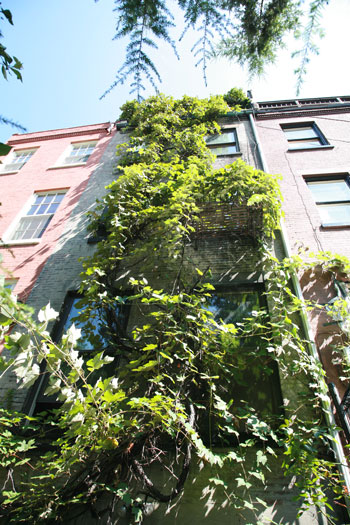
Latif Jiji, a mechanical engineering professor at New York University, is the proud owner of Manhattan’s only vineyard and the family-operated winery, “Chateau Latif.” He resides with his wife, Vera, in the Upper East Side. The vineyard’s story began in 1977 when Latif purchased a grapevine from a local nursery. He planted the vine secretly on their property, concealing it from his wife. Vera only noticed the new plant when it had grown significantly.
The vineyard bore its first Niagara grape harvest in 1984. Over time, the vineyard expanded significantly. It starts in the garden, climbs along a 50-foot house wall, spans four stories, and continues up to the roof. To support this extensive growth, Latif constructed a sturdy metal framework of beams and posts on the roof, ensuring the vines remained secure.
The Farm’s Operations
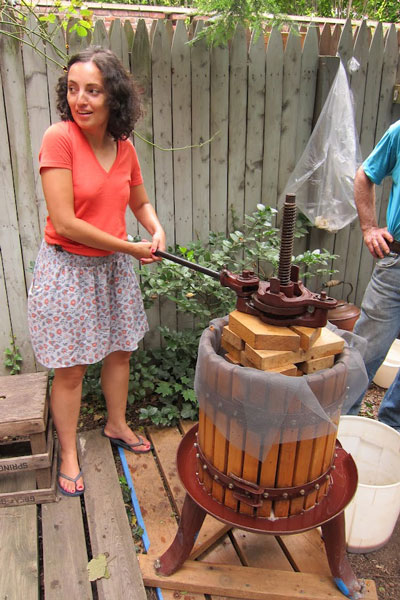
Managing and harvesting the vineyard is a meticulous process that requires precision. Before harvest, Latif uses a specialized device to assess the grapes’ ripeness and sugar content. His findings show that grapes further from the stem are usually sweeter. Harvesting typically takes place in late August or early September, depending on the weather and ripeness. Latif records every harvest detail in a notebook, documenting the yield and the people involved.
In the vineyard’s early years, Latif harvested grapes with his daughter. Over time, the “team” grew to 20–25 people, including family members and friends of his children. Sometimes, there were so many participants that Latif had to appoint a “team leader” to assign tasks and oversee the process. Each participant had a specific role, such as harvesting grapes, sorting and washing, collecting fallen fruit, or transporting grape clusters from the roof. The vineyard’s largest yield was approximately 712 pounds of grapes.
After harvesting, the grapes are moved to the basement, where a machine removes the stems, and the fruit is juiced. The juice is then stored in glass containers to ferment. After fermentation, the wine is prepared and moved to a climate-controlled storage room.
Challenges Faced by the Vineyard
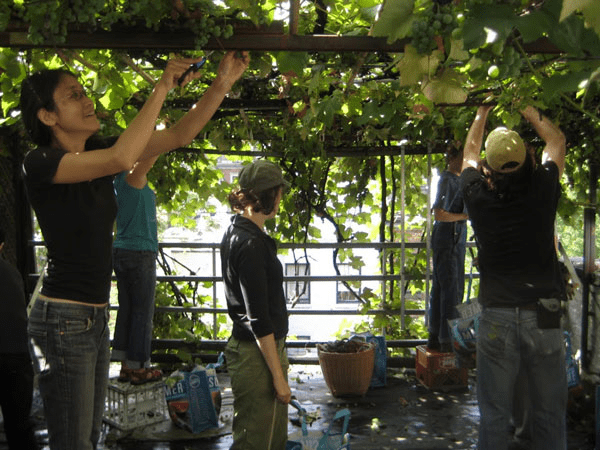
One significant challenge Latif Jiji encounters is determining when the grapes are ready for harvest. The ripening process is uneven, particularly in terms of sugar levels. Factors such as varying sunlight exposure, leaf density, and crown thickness contribute to inconsistent sugar content in the grapes. For instance, grapes closer to the ground may measure 11° Brix, while those at the top can reach 18° Brix.
A Glimpse into the Life of Latif Jiji
Latif Jiji was born in Baghdad, Iraq, into a Jewish family as the youngest of five children. He moved to the United States in 1947, where he pursued higher education. He graduated from the Massachusetts Institute of Technology (MIT) with a degree in mechanical engineering and spent his career teaching. Latif has never returned to his homeland, and his vineyard holds deep personal significance. For Latif, it represents a cherished family tradition, as his father also cultivated grapes and made wine.