

The Harlem Ship Canal is a significant 19th-century engineering achievement that stimulated trade, industry, and other economic activities. Learn more about its inception, construction, and grand opening below on Manhattanname.
The Idea
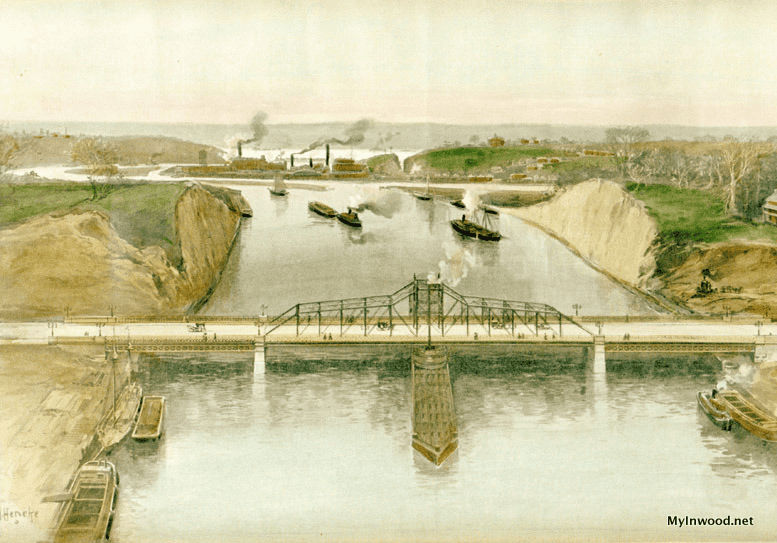
The Harlem Ship Canal, located in Upper Manhattan, was built to connect the Hudson River with the East River, creating a direct navigable route between the Atlantic Ocean and the Great Lakes.
The 19th century was a golden era for shipping, with waterways serving as the backbone of economic and commercial activities. Recognizing this, Manhattan and nearby cities saw the construction of the canal as a commercially advantageous endeavor. In 1829, the “Harlem River Canal Company” received authorization to build the canal. By 1881, surveys of suitable locations commenced, and engineers ultimately selected the simplest and most cost-effective route through “Dyckman’s Meadows,” connecting the Harlem and Hudson Rivers. The estimated cost of the project was $2.7 million.
Construction
Construction on the canal began on January 9, 1888, with approximately 200 workers. The chosen route passed through agricultural lands. Initially, two water-retaining dams were built on either side of the rivers. Workers used explosives to break through the hard rock between the rivers, manually removing debris and excavating. Their efforts resulted in a canal 1,200 feet long, 350 feet wide, and 85 feet deep.
The project, however, faced challenges. The dams proved unreliable and were destroyed multiple times, including a catastrophic incident in 1893 during an unprecedented tidal surge. This event flooded the unfinished canal, forcing engineers to decide between draining it entirely or completing construction underwater. Ultimately, they chose the latter, which presented significant risks and difficulties.
Initially, the canal had a winding route. While a straight path would have been ideal for navigation, it was obstructed by a strategically important steelworks facility that manufactured weapons and ammunition for the U.S. military. Decades later, in 1936, after the plant was decommissioned, the canal was straightened.
The Canal’s Grand Opening
The canal was officially opened in 1895 to much fanfare. Manhattan residents eagerly anticipated the event, and around half a million spectators lined the banks of the Harlem and Hudson Rivers. The event was hailed as monumental by contemporary media.
Before the ceremony, an American cruiser anchored on the Hudson River alongside flag-adorned tugboats, motorboats, private yachts, and steamships, all awaiting the starting signal. At noon, cannon fire signaled the start of the celebration, and the flotilla ceremoniously entered the canal. The event featured a formal ceremony led by New York’s 90th mayor, William Lafayette Strong, and concluded with a spectacular fireworks display.