

Park · Manhattan · ⭐ 9.5/10 · 67643 reviews · updated: 2026-08-04 20:06:33
Address: New York, 10011, United States
The High Line — a mile and a half of derelict freight viaduct, rebuilt as a garden in the air
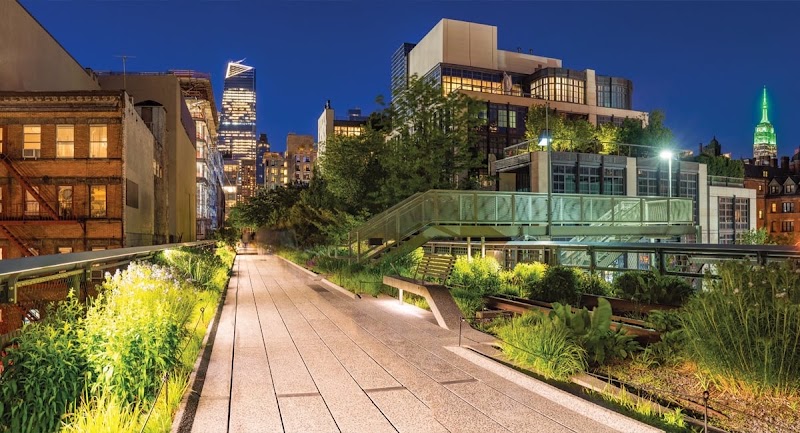
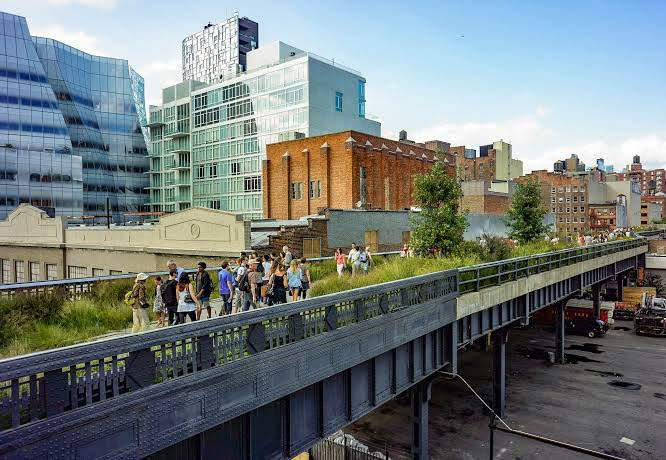
Thirty feet above the pavements of the West Side, a steel viaduct that once carried meat, dairy and mail into the upper floors of Manhattan’s warehouses now carries about eight million people a year through a planted landscape. The High Line runs 1.45 miles from the Meatpacking District through West Chelsea to Hudson Yards, and it exists because two neighbourhood residents refused to accept that it should be torn down. What they saved was not just a structure but a specific accident: after the last train ran in 1980, wind and birds seeded the ballast, and within two decades the abandoned track bed had become a linear wild meadow suspended over the city. The park built between 2009 and 2019 is an argument that the accident was worth keeping — its planting, by the Dutch designer Piet Oudolf, deliberately recreates the self-seeded grasses and perennials that grew there while nobody was looking.
Highlights
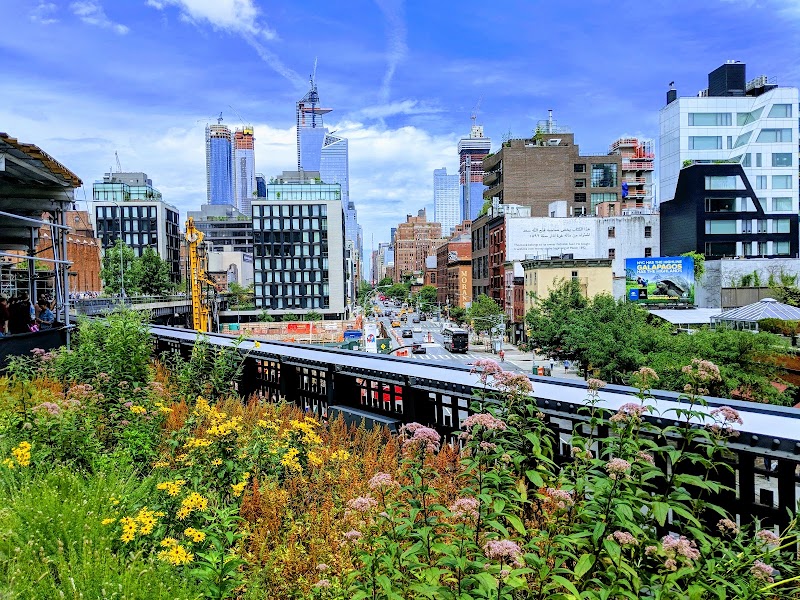
- The planting by Piet Oudolf — roughly 400 plant species and over 100,000 individual plants, set in soil averaging just eighteen inches deep and spaced at six to eight plants per square foot. Oudolf plants for structure and seed head as much as for bloom, so the dried stems and grass heads are left standing through winter rather than cut down; a permanent team of horticulturists works the beds year-round.
- The 10th Avenue Square and Overlook — a small sunken amphitheatre of stepped wooden seating facing a plate-glass window set into the viaduct, framing the avenue and its traffic below as if it were a film. It is the single cleverest moment in the design and the one most people remember.
- The Diller–von Furstenberg Sundeck and Water Feature — a broad deck of teak loungers, some of them on wheels running on salvaged rail track, with a shallow film of water flowing across a section of the path in summer for anyone who wants to walk through it barefoot.
- The Spur and the High Line Plinth — the widened section that opened on 4 June 2019 carries the Plinth, one of the very few sites in New York dedicated permanently to a rotating programme of major commissioned sculpture, launched with Simone Leigh’s monumental bronze “Brick House”.
- The Chelsea Market Passage and the Falcone Flyover — the path runs directly through the lower level of the old Nabisco bakery complex, now Chelsea Market, then lifts onto a narrow steel walkway raised eight feet above the deck so that visitors pass through the crowns of magnolias and sumacs.
- The Moynihan Connector — opened in June 2023, a pair of bridges linking the Spur to Manhattan West and on to Moynihan Train Hall: a 260-foot Warren truss built from sustainably sourced Alaskan yellow cedar glulam, and a Woodland Bridge with soil beds deep enough to carry a ribbon of real trees.
What you’ll find
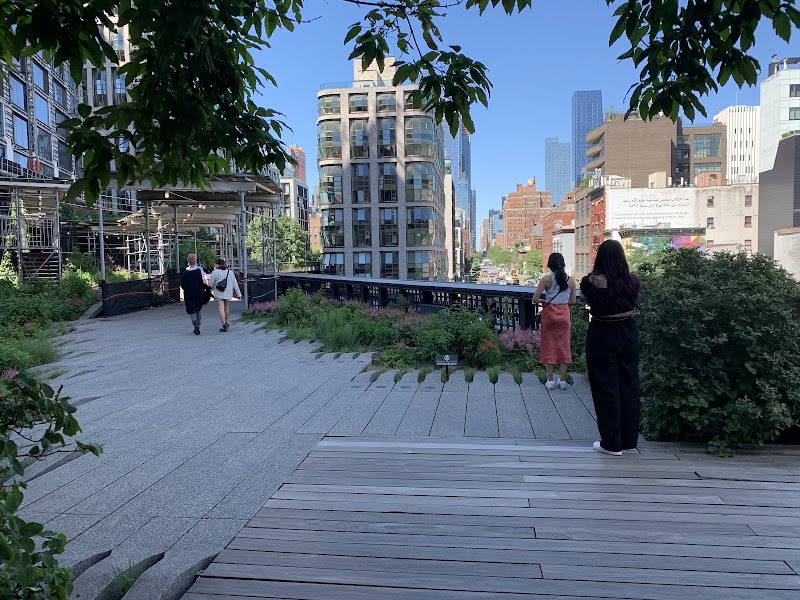
The park was designed by James Corner Field Operations with the architects Diller Scofidio + Renfro and Piet Oudolf, and its governing idea is the fusion of hard surface and planting the designers called “agri-tecture”: tapered concrete planks with open joints, so that grasses and perennials appear to grow up through the walkway rather than beside it. The result changes character every few hundred feet.
- Gansevoort Woodland and the southern stair — the park’s original entrance climbs through a grove of grey birch that turns luminous in winter, with the Whitney Museum of American Art, opened here in 2015, standing directly at the foot of the steps.
- Peel-up benches and the Radial Bench — the timber planks of the walkway rise out of the surface to become seating, so the furniture is literally continuous with the floor; a long curved bench near the Chelsea Grasslands follows the original curve of the rail alignment.
- Chelsea Grasslands, Wildflower Field and Rail Yards — the middle and northern stretches carry the most naturalistic planting, and in the Rail Yards section, an Interim Walkway preserves a length of the self-seeded landscape and the original track almost exactly as it was found.
- Pershing Square Beams — a children’s play area in the Rail Yards where the concrete deck was stripped back to expose the original structural steel beams, coated in soft silicone so kids can climb, crawl and hang from the bones of the viaduct itself.
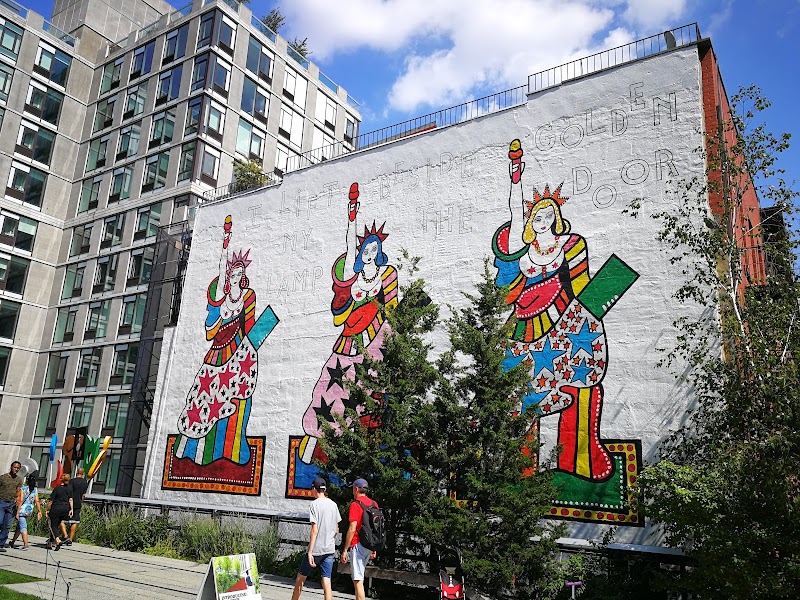
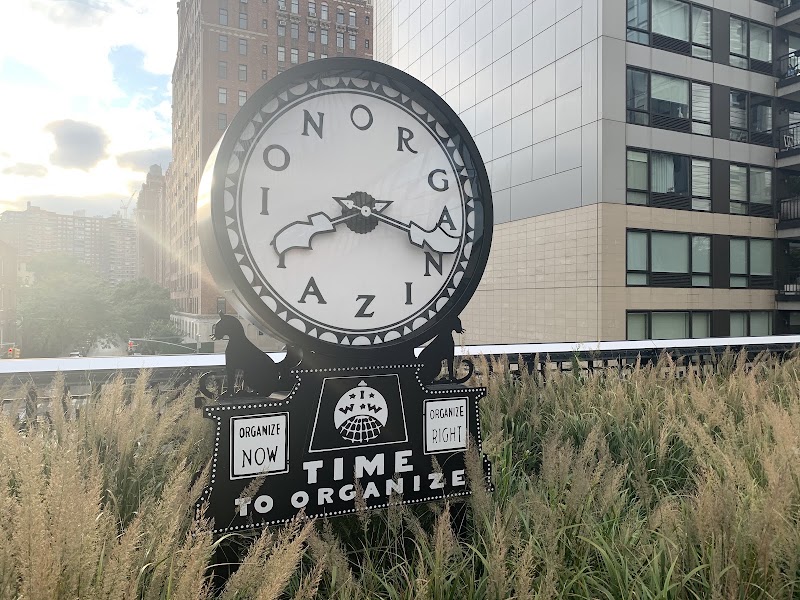
- High Line Art — a continuously changing programme of commissioned sculpture, billboards, performance and video sited along the length of the park, in addition to the Plinth, run by the park’s own curatorial team.
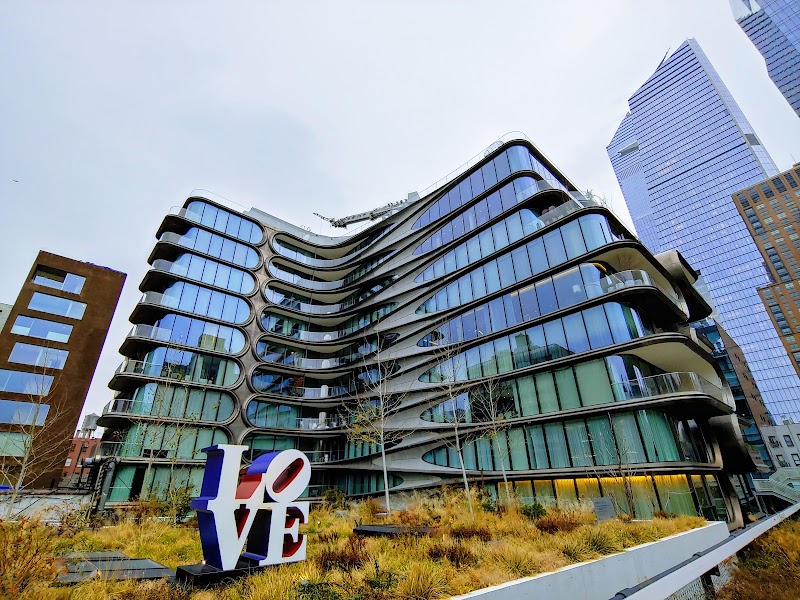
- Views and neighbours — the Hudson River, the Statue of Liberty on a clear day from the southern end, the Empire State Building framed by the corridor, the galleries of West Chelsea below, Little Island in the river, and at the northern end the towers of Hudson Yards.
Things to do — and who it’s for
- Walkers and first-time visitors — the full length takes about forty-five minutes without stopping and closer to two hours if you actually look; it is the most efficient way to read the transformation of the West Side in a single line.
- Gardeners and plant people — this is one of the most influential planting schemes of the last quarter-century, and it rewards repeat visits in different months more than almost any garden in the city.
- Photographers — the viaduct puts you at second-storey height with clear sightlines down the cross streets to the river, and the low light of early morning and the hour before closing is exceptional.
- Art audiences — the Plinth, the billboard commissions and the rotating installations, combined with the Whitney at the southern end and the Chelsea gallery district immediately below, make a full day of contemporary art without a car.
- Families — the Pershing Square Beams, the summer water feature and the sheer novelty of a garden in the air work well with children, though the park is a walking route rather than a running-around space and gets busy.
- Commuters and city walkers — since the Moynihan Connector opened, the park functions as a genuine pedestrian route between Moynihan Train Hall and the Meatpacking District, away from traffic the entire way.
Getting there & practical
The High Line begins in the Meatpacking District at the southern end, runs the length of West Chelsea and ends in Hudson Yards, with the Javits Center beyond. The A, C, E and L lines serve the southern half from the edge of Greenwich Village and Chelsea; the 1 line runs a couple of blocks inland with stops close to the middle entrances; the 7 line terminates at Hudson Yards at the northern end; and the Moynihan Connector links the park directly to Moynihan Train Hall, where the commuter and intercity rail networks meet a large cluster of subway lines. Entry is free and unticketed. There are eleven public access points; five are wheelchair-accessible, with elevators at four locations plus level entry at Hudson Yards and at the Connector. The park opens at seven in the morning year-round and closes at ten at night from the start of April to the end of November, and at eight at night through the winter. Bicycles and skateboards are not permitted on the deck and dogs are excluded apart from service animals; bike racks and bike-share docks sit at street level near most stairs. Food and drink kiosks operate seasonally along the route, and free docent-led tours run on selected days. Allow ninety minutes end to end at a comfortable pace, and note that the walkway is narrow — midday on a summer weekend is genuinely crowded.
When to visit
Spring is when the bulbs and early perennials come through the grasses and the birches and magnolias flower, with the whole corridor still open and legible before the canopy fills in. Summer is the busiest and the most theatrical: the water feature runs, the Sundeck fills, evening light along the river is the reason people come at seven in the evening rather than noon, and the crowds are heaviest between late morning and mid-afternoon. Autumn is the connoisseur’s season, and arguably the point of Oudolf’s whole design — grasses turn bronze and copper, seed heads dominate, and the planting holds its structure through October and November. Winter is the park most visitors never see: bare stems left standing on purpose, frost on the seed heads, low sun down the cross streets, and stretches where you can walk a hundred metres without meeting anyone.
Good to know
The viaduct exists because the street-level railway that preceded it was killing people. From the 1840s, freight trains ran directly along the surface of the West Side among carts, pedestrians and horses, and the death toll was severe enough that the route acquired the nickname Death Avenue; the railroad’s answer, for decades, was to employ mounted riders known as the West Side Cowboys who trotted ahead of each train waving a red flag. The permanent fix came with the West Side Improvement, a vast public-private undertaking that lifted the tracks onto an elevated structure. The High Line opened to freight in 1934, and its most unusual feature was that it did not run above the avenue at all: it ran through the middle of the blocks and directly into the buildings, so that trains could be unloaded inside factories and warehouses without ever blocking a street. The Nabisco bakery complex it passed through survives as Chelsea Market. Trucking killed the traffic. The southernmost section was demolished in the 1960s, and the last train ran in 1980 — three carloads of frozen turkeys. For nearly twenty years the structure stood empty and slowly turned into a self-sown meadow of grasses, sumac and wildflowers, while property owners below lobbied for demolition. In October 1999, at a community board meeting on that very question, two local residents, Joshua David and Robert Hammond, met and founded Friends of the High Line to argue the other way. Joel Sternfeld’s photographs of the overgrown track bed did much of the persuading. In 2004 a design team was chosen: James Corner Field Operations as lead, Diller Scofidio + Renfro as architects, and Piet Oudolf for the planting, with the Promenade plantée in Paris, completed in 1993, as the acknowledged precedent. The first section opened on 8 June 2009, the second on 7 June 2011, the third — the curve around the West Side Rail Yards — in September 2014, the Spur on 4 June 2019, and the Moynihan Connector, designed by Skidmore, Owings & Merrill with Field Operations, in June 2023. The consequences went well beyond the park. West Chelsea was rezoned in 2005 to channel development around the structure; property values along the route rose sharply, several dozen towers went up within a few blocks, and Hudson Yards rose at the northern end. That success is also the park’s most serious criticism: the neighbourhood it saved became dramatically more expensive, and long-standing residents and small businesses were priced out — a pattern the park’s own founders have publicly acknowledged and which the High Line Network, an offshoot advising similar infrastructure-reuse projects in other cities, was set up partly to address. The park is owned by the City of New York and operated in partnership with Friends of the High Line, which raises the large majority of its annual operating budget from private sources.
Visitor tips
- Walk it from north to south in the late afternoon: you finish in the Meatpacking District with the light off the Hudson behind you and dinner options at the bottom of the stairs, rather than finishing beside a rail yard.
- Use the lesser-known access points rather than the southern stair — the mid-Chelsea entrances are far quieter, and the elevators at four locations save the climb entirely if you have a pushchair or limited mobility.
- Go early. The park opens at seven in the morning, and the first two hours are the only time the walkway is empty enough to photograph properly or to stop in front of a planting bed without blocking anyone.
Questions & answers
Is the High Line free? Yes, entry is free at every access point and there are no tickets. Free docent-led tours run on selected days. Only the food and drink kiosks along the route charge, and some private evening events are ticketed by their organisers.
How long does it take to walk the whole thing? The full 1.45 miles takes roughly forty-five minutes at a steady pace and around ninety minutes to two hours if you stop at the overlooks, the Plinth, the water feature and the planting. Adding the Moynihan Connector at the northern end extends it by a few minutes.
Can I cycle, skateboard or bring my dog? No to all three. The deck is narrow and heavily used, so bicycles and skateboards are prohibited on the park itself and dogs are not permitted apart from service animals. Bike racks and bike-share docks are available at street level near most of the stairs.
Is it accessible for wheelchairs and pushchairs? Yes, though not from every entrance. Five of the eleven access points are wheelchair-accessible, with elevators at four locations and level entry at Hudson Yards and at the Moynihan Connector. The deck itself is flat and smooth for its entire length.
What was the structure before it was a park? An elevated freight railway, part of the New York Central’s West Side Line, opened in 1934 to lift trains off the street after decades of fatal accidents on the surface route. It ran through the middle of city blocks and directly into warehouses so goods could be unloaded indoors. The last train ran in 1980, carrying frozen turkeys, and the structure then stood derelict for nearly twenty years.
Who designed it, and who saved it? Friends of the High Line, founded in October 1999 by Joshua David and Robert Hammond, campaigned against demolition and won. The design team appointed in 2004 was James Corner Field Operations with Diller Scofidio + Renfro, and the planting is by Piet Oudolf.
When is the planting at its best? Late spring for bulbs and flowering trees, high summer for perennials, and September through November for the grasses and seed heads that the scheme is genuinely built around. Winter is deliberately not cut back, so the structural stems and frost-covered seed heads are part of the design rather than an off-season.
Is it worth visiting if I dislike crowds? Yes, but choose your hour. Between eleven and four on a summer weekend the walkway is packed and stopping is difficult. Early morning, evenings towards closing, and any weekday in winter give you a genuinely quiet park.
Photos
Show 1 more photos
Visitor reviews
Reviews last updated: 2026-08-04 20:06:33
Data is refreshed monthly. Sources: manhattanname.com and editorial picks based on reviews.
A great place for a long walk. Very atmospheric
A very nice, interesting and convenient place for walking around the city
The place is very beautiful and cool. A very long route past designer buildings and sculptures, and what nature! I recommend this place. It's perfect for a break from the constant stone jungle of DownTown. I was there on…
A wonderful route for a walk!